“It’s Just a Wild, Wild West” Harnessing Public Procurement as an AI Governance Mechanism
The public sector is increasingly using artificial intelligence (AI). These systems may affect civil society both directly and indirectly. Directly, when AI influences decisions about benefits, services, or rights. Indirectly, when automated systems shape how public institutions allocate resources, set priorities, or interpret data. For that reason, it is crucial that governments use AI responsibly.
But governments rarely build these systems themselves. Instead, they typically buy them from private companies.
What is public procurement
Public procurement does not sounds very sexy. But as a governance instrument, it can be surprisingly powerful.
Most things governments buy, from office chairs to large infrastructure projects, are purchased through a formal process called public procurement. In simple terms, this is the procedure through which public authorities invite companies to submit bids for a product or service, compare those offers, and award a contract to the supplier that best meets the defined criteria. The same process increasingly applies to digital systems, including AI.
When publishing a tender, public authorities can define requirements: transparency obligations, fairness criteria, documentation standards, or evaluation procedures. Companies then compete to meet those requirements.
In other words, procurement can shape which technologies enter the public sector—and under what conditions.
Public procurement as AI governance mechanism
Emma Kallina and I started wondering whether this purchasing process could serve as an AI governance mechanism. Could procurement rules help ensure that AI systems systems align with public values?
To explore this question, we spoke with a range of experts across the EU and the UK, including public-sector buyers, technology suppliers, consultants, and procurement specialists with long experience in the field. The study draws on semi-structured interviews with professionals who work directly with procurement processes.
We focused on three questions:
How does the public sector currently acquire AI systems?
What challenges prevent procurement from serving the public interest?
What practices could help public procurement better shape AI systems?
How governments currently acquire AI
One key observation is that AI procurement is still relatively immature. AI-specific procurement processes are only beginning to emerge, but is very messy and ad-hoc. Participants described the current landscape as fragmented and difficult to map.
Often, AI appears as part of broader IT systems: cloud services, software platforms, or data infrastructure. Governments often follow the same templates and procedures used for traditional IT procurement, which do not always account to risks unique to AI (i.e. bias in training data, rapid developments, opaqueness).
But there are also other ways AI enters the public sector:
Many AI capabilities are introduced through existing contracts. For example, a software platform may add AI features through updates. From the perspective of procurement, the organisation has not purchased a new AI system, even though new AI functionality suddenly appears inside an existing service.
Governments often purchase AI systems through framework contracts. These umbrella agreements pre-select suppliers and allow public bodies to buy services without launching a new tender each time. While this makes procurement faster, it can also reduce scrutiny of specific AI components. For example, public organisations that already use Microsoft services through a framework agreement can often add tools like Copilot directly to existing contracts. From a procurement perspective nothing new is purchased yet a new AI capability has entered the organisation.
AI sometimes enters through pilot projects or experimental deployments that remain below procurement thresholds. These pilots can later evolve into long-term systems without ever going through a full procurement process.
The result is that AI often enters the public sector through channels that provide limited visibility and oversight.
Main challenges
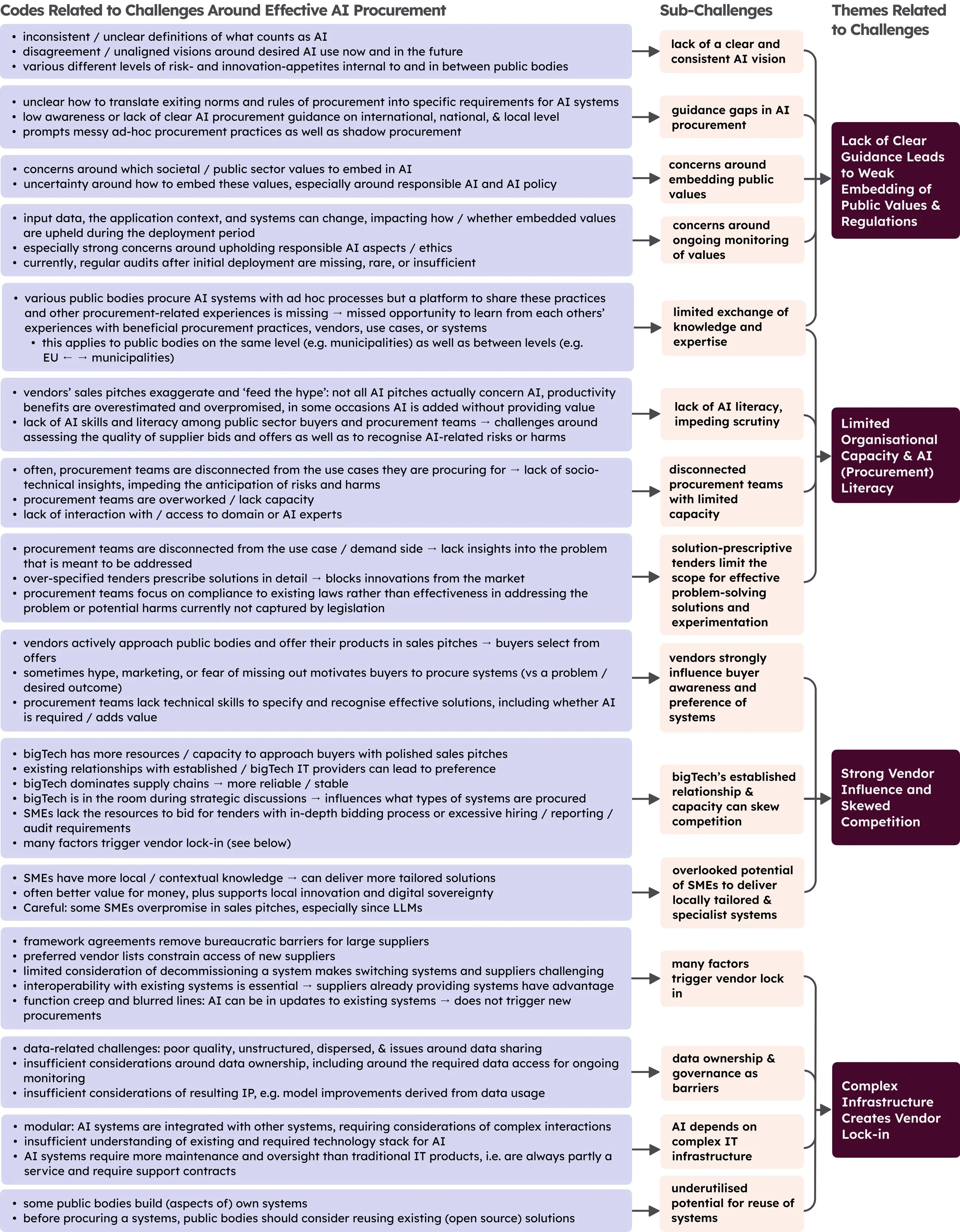
Across the interviews, several recurring challengesemerged.
Lack of clear guidance. Many procurement teams are unsure how existing procurement rules translate to AI systems. As one participant put it, “there is no clear guidance yet… everything is still new and people are figuring it out.” Concepts such as fairness, accountability, or transparency are widely discussed in policy debates, but procurement officers often struggle to turn these principles into concrete tender requirements.
Capacity and expertise. Procurement teams are typically responsible for purchasing everything from office supplies to complex digital systems. As one participant put it, they might buy “post-its on Monday and AI on Tuesday.” Evaluating sophisticated AI systems requires skills and resources that many teams simply do not have. Several interviewees noted that many public authorities “are not really well equipped to deal with all the complexities of AI.”
Strong vendor influence. In practice, many AI conversations start with vendors rather than with public problems. Technology companies approach governments with polished sales pitches and ready-made systems. As one participant put it, large providers simply have “a lot of manpower to sell stuff.” When procurement teams lack the time or expertise to push back, suppliers can end up shaping both the agenda and the solutions that follow.
Complex digital infrastructures create vendor lock-in. AI systems rarely operate independently. They are typically embedded in larger digital infrastructures: cloud platforms, data pipelines, and legacy software. As one participant noted, understanding these systems often requires looking at “the entire technology stack. Once integrated, switching providers becomes expensive and technically difficult. This gives existing suppliers a significant advantage.
Taken together, these dynamics mean that private technology providers often hold considerable influence over which AI systems are adopted and how they function. The result is that decisions about which AI systems enter the public sector are often shaped as much by vendors and existing infrastructures as by deliberate public choices. Or, as one interviewee put it: “It’s still a bit of a wild, wild west.”
Promising practices
Despite these challenges, the interviews also revealed a number of promising practices that could strengthen public-sector AI procurement. In our paper, also outline actionable mechanisms to achieve these promising practices. Please get in touch if you want access to the paper.
Provide clearer vision and guidance
Participants repeatedly emphasised the need for clearer guidance on how AI should be used and procured in the public sector. This includes not only high-level strategy but also practical tools: procurement guidance, standards, and contractual clauses that translate responsible AI principles into concrete procurement requirements.
Share knowledge and experiences
Many public bodies face similar procurement questions but often work in isolation. Participants highlighted the value of stronger knowledge-sharing across the public sector: platforms, networks, or repositories where organisations can exchange procurement practices, vendor experiences, and lessons learned.
Build organisational capacity
Another recurring practice concerns strengthening procurement capacity. Interviewees stressed the importance of interdisciplinary teams that bring together procurement professionals, technical experts, legal advisers, and domain specialists. Building AI literacy and technical expertise inside procurement teams can help public buyers better evaluate systems and vendor claims.
Focus on outcomes rather than solutions
Several participants argued that procurement processes should begin with defining the problem to be solved, rather than prescribing a specific technical solution. By focusing on outcomes instead of predefined technologies, public authorities can allow suppliers to propose different approaches and potentially more suitable solutions.
Monitor systems after deployment
Participants also stressed that procurement should not end when a contract is awarded. AI systems can evolve over time as models are updated or data changes. Mechanisms such as audits, evaluations, and ongoing monitoring can help ensure that systems continue to operate in line with public-sector values and requirements.
Considering the broader technical and data infrastructure
Finally, interviewees emphasised that AI systems are rarely stand-alone products. They typically depend on wider infrastructures, including cloud services, data pipelines, and legacy systems. Effective procurement therefore requires considering this broader technical context, including issues such as interoperability, data governance, and vendor dependencies.
Conclusion
Public procurement is rarely discussed in debates about AI governance. Most attention focuses on regulation, standards, or ethical guidelines. Yet procurement sits at a crucial point where policy decisions translate into real systems deployed in the public sector.
If governments specify meaningful requirements during procurement, they can shape how AI systems are designed and deployed. If they do not, the market will largely decide.
Public procurement may not solve all of those challenges. But it represents a powerful—yet often overlooked—tool for shaping how AI systems enter public institutions.
At the moment, procurement’s potential as an AI governance mechanism appears underutilised. The systems entering the public sector are often shaped as much by vendor offerings and existing infrastructures as by deliberate public-sector choices.
This suggests that procurement deserves far more attention in discussions about AI governance.
What’s next?
We are currently working on follow-up projects on:
Effective stakeholder involvement in public AI procurement
Open source AI procurement
Read more
🎉 We received an Honourable Mention Award for originality, rigor, and potential impact! 🎉
Our paper will be published in April 2026, after Emma Kallina and I have presented our work at the ACM CHI Conference in Barcelona. If you would like to be sent the publication, please get in touch.
Hudig, A.I.*, Kallina, E.M.*, & Singh, J. (2026). “It’s Just a Wild, Wild West”: Harnessing Public Procurement as an AI Governance Mechanism. In Proceedings of the 2026 CHI Conference on Human Factors in Computing Systems (CHI ’26), April 13–17, 2026, Barcelona, Spain. ACM, New York, NY, USA. https://doi.org/10.1145/3772318.3791968. *shared first authors.