Travelling through the UK with a flying car
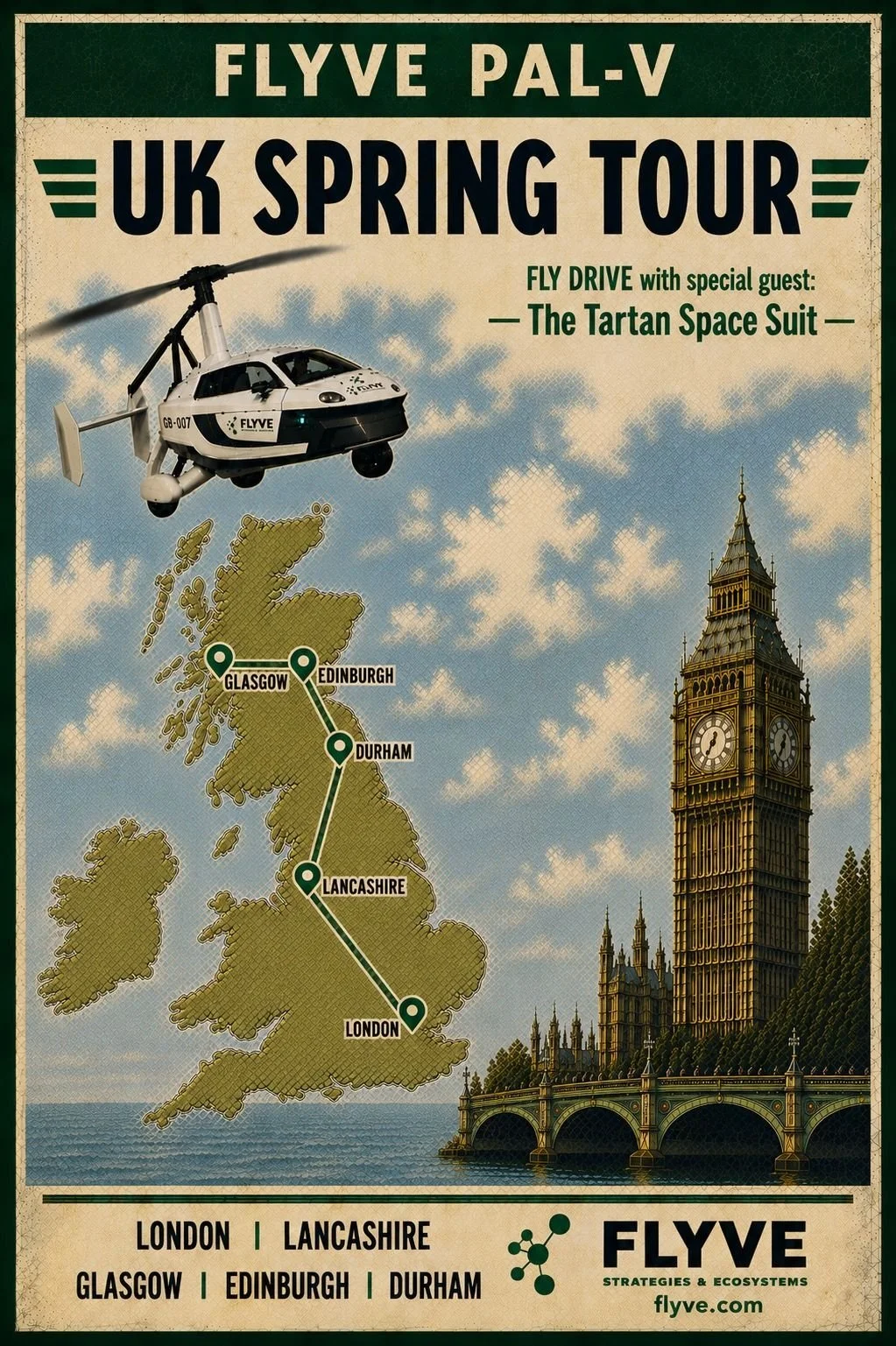
In May 2026, I joined FLYVE and PAL-V on a tour through the UK with something that still sounds like science fiction: a road-legal flying car.
The PAL-V is a vehicle that can drive on public roads and fly as a gyroplane. It can be used as a car on the road, and it can also convert into an aircraft. That makes it different from many other future mobility concepts, because it does not depend only on one mode of transport. On the road, it can reach speeds of up to 170 km/h. In the air, it can fly up to 500 km on normal petrol.
Together with FLYVE, we wanted to start a broader conversation: what could this kind of mobility mean for professional, public-sector, and societal applications? Where might fly-drive platforms actually make sense? And how do we make sure that new mobility systems are not only technically impressive, but also useful, responsible, and connected to real-world needs
Why we went on tour
FLYVE is PAL-V’s largest European strategic partner and customer. Its work focuses on creating professional ecosystems around fly-drive mobility: not only the vehicle itself, but also the partnerships, infrastructure, use cases, and governance questions that come with it:
What happens when low-altitude air mobility becomes more practical?
Which public-sector needs could this support?
How might professional users integrate fly-drive platforms into existing operations?
What infrastructure, skills, regulation, and trust will be needed?
Therefore, we went into conversations with governments, universities, industry, local authorities, educators, investors, civil society, and communities.
Where we went
During the UK tour, the FLYVE and PAL-V team visited several locations, including London, Lancashire, Glasgow, Edinburgh, and Durham.
In London, the PAL-V was shown at the Guildhall in the City of London. Beneath the Guildhall lies the old Roman amphitheatre of London.
In Lancashire, the conversation became very practical. At the University of Lancashire’s Altitude Facility at Warton Enterprise Zone, we presented the car to BAE systems.
In Glasgow, the tour included events with Glasgow City of Science and Innovation, Glasgow Science Centre, and Barclays Eagle Labs. These discussions connected future mobility with Scotland’s innovation ecosystem, space, heritage, and investment.
In Edinburgh, the visit to Edinburgh College placed the emphasis on skills. Flying cars and space technologies may grab attention, but they also raise a more practical question: who will build, maintain, regulate, operate, and improve these systems?
In Durham, the conversation with Durham University Business School focused on aerospace, space technologies, cybersecurity, societal challenges.
Possible applications
A flying car naturally invites imagination. Several professional and societal applications came up throughout the tour.
One possible use is emergency response. In situations where roads are congested, damaged, or simply too slow, a fly-drive vehicle could help move people or equipment more flexibly. This could be relevant for medical support, disaster response, remote access, or urgent public-sector operations.
Government operations are another potential field. Public authorities often need to move between urban, rural, and remote locations. A vehicle that can use both road and airspace could support inspection, monitoring, coordination, or rapid deployment tasks.
There are also possible applications in infrastructure, energy, and security. For example, professional users may need to access dispersed sites, inspect critical infrastructure, or respond quickly across a region.
And then there is the broader question of regional connectivity. Some places are not badly connected because they are far away, but because the available routes are inefficient. Fly-drive mobility could open up new ways to think about distance, access, and resilience.
Of course, none of this happens automatically. New mobility systems require infrastructure, regulation, training, insurance, public trust, and careful integration with existing systems. A fly-drive platform is not just a vehicle. It is part of a wider system. It depends on airspace rules, road regulations, landing sites, maintenance capacity, fuel infrastructure, digital systems, public acceptance, professional training, and organisational readiness.
This is why the tour was valuable. It brought the PAL-V into rooms where people could move beyond “isn’t this amazing?” and start asking “what would it take to make this useful?”